
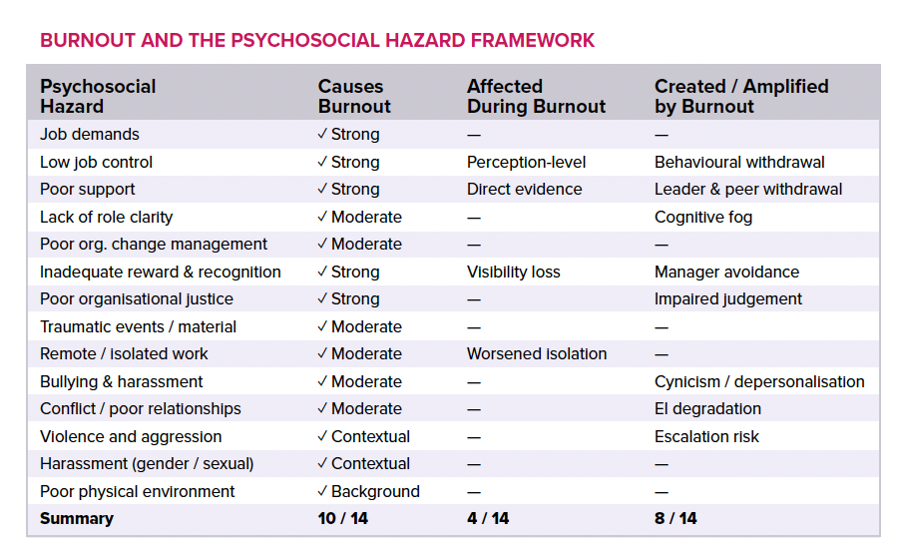
Burnout is connected to every psychosocial hazard
No time to read? Click play to listen

Download your copy of my white paper, and you have all the evidence you need to make the business case for dealing with the burnout you are seeing in your workplace.
As I said in my previous newsletter, I have done the hard yards here, so you don’t have to. One of the clearest findings from this work is also one of the hardest for organisations to ignore.
It is already showing up as a cost on the books, and it doesn’t have to! In fact, we are now at a tipping point where it is cheaper to fix the problem than to let it slide.
Burnout is connected to every psychosocial hazard.
That matters because many businesses still treat burnout as if it sits in a separate wellbeing box.
Sometimes that is true. But if we stop there, we miss the pattern. Burnout is not simply what happens when someone works too many hours. It is what happens when job demands remain high, control remains low, support is patchy, roles are unclear, recognition is absent, change is poorly managed, relationships deteriorate, and people feel they have little influence over the pressure being placed on them.
And in looking for the pattern it may help to think of it like this:
• If one person is showing signs of burnout, then it may be a person-centric issue and we start there. Someone is tired. Someone has lost motivation. Someone needs rest, support, coaching, perhaps time away from work
• If a team is showing it, then we are most likely looking at a relational issue (emotional contagion, collective frustration) and the leader is out of ideas, so it is spreading.
• But when it is wide-spread across the business or division, then we cannot ignore the work design and culture approach.
Basically, we look for the fire and not just the smoke. In other words, burnout is often the point where multiple psychosocial hazards collide. It is a symptom, and not where the problem lies.
That is why it becomes so expensive.
The person experiencing burnout is not only tired. They may begin withdrawing behaviourally, their visibility drops, their judgement is affected, their tolerance narrows, relationships become harder. Trust erodes, managers avoid difficult conversations because they do not know what to say. Colleagues compensate, then they become overloaded too.
The risk spreads.
A single burnout case can quietly amplify the very hazards that helped create it.
Poor support becomes poorer, conflict becomes sharper, isolation deepens. Role clarity becomes harder to maintain. Recognition disappears because the person is no longer performing in the way they once did. Leaders become reactive. Teams start building stories around who is coping and who is not.
This is why Jennifer Moss’s point is so important: burnout is an organisational problem.
That does not remove personal responsibility, and it certainly does not mean every individual experience is identical. It means the organisation has to look at the conditions that make burnout more likely, more frequent and more damaging.
Successful organisations are beginning to map burnout differently.
They are asking:
• Which hazards are causing burnout here?
• Which hazards are being amplified by burnout?
• Where are we seeing withdrawal, avoidance, conflict or reduced trust?
• What is the system telling us before people leave?
This is a more mature conversation than simply asking people to be more resilient. Because resilience without redesign is just endurance. And endurance has a cost.
The real opportunity is to use burnout as an early warning signal. Not to blame individuals or managers, but to understand where the organisation is leaking energy, talent, trust and performance.
Once we see burnout as connected to every psychosocial hazard, the response becomes clearer.
• We protect people.
• We reduce risk.
• We retain capability.
• We stop losing good people to preventable conditions.
That is the work now.
I can help you map a route out of burnout and into thriving workplaces. Let’s have a chat.
