
Burnout is just the smoke, you need to find the fire.
No time to read? Click play to listen

I have done all the hard work here so you don’t have to. Please feel free to download the white paper here to set you up with a solid business case to take action on burnout in your organisation. Everything you need to arm yourself with the financial, legal and human reasons for doing so.
Most organisations know what burnout looks like once it becomes visible.
Performance drops, absence rises, good people go quiet. Leaders start noticing missed deadlines, mistakes, withdrawal, frustration, cynicism, or the employee who was once fully engaged now doing only what is required to get through the day.
That is the visible crisis. And because it is visible, it often gets the only response.
Time off (as a solution, it is a waste of time, by the way) EAP service. Coaching. A wellbeing webinar. A lighter week if the team can manage it.
These are often kind, necessary and well-intended responses. We need them, for sure, because when someone is already depleted, triage matters. Stopping the haemorrhaging matters.
Keeping our best people in the business, and giving them back to their families with something left in the tank, matters enormously.
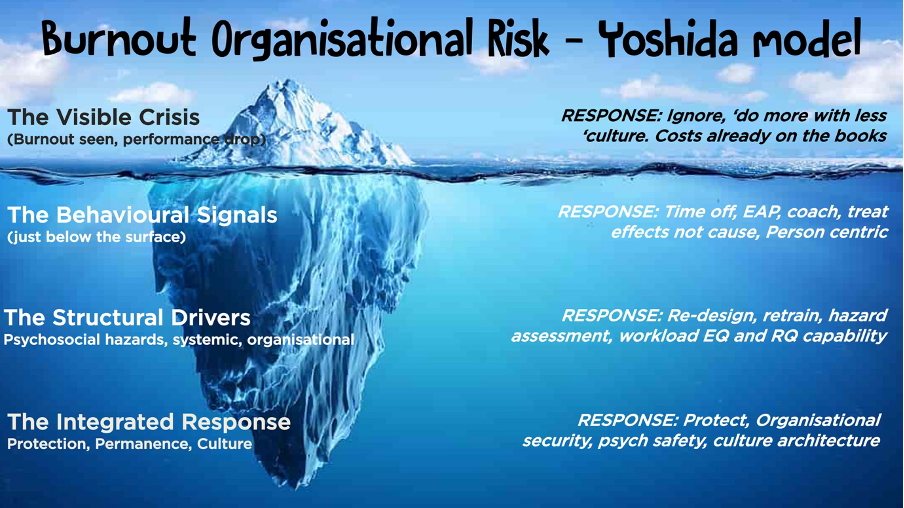
But the iceberg asks a more uncomfortable question.
What is happening underneath?
Because burnout rarely appears from nowhere. It is the end process of a long series of signals we kept missing.
It is usually the visible result of deeper behavioural signals and deeper still, structural drivers.
Workload…poor role clarity…low job control…poor support…low recognition…organisational change that keeps landing without recovery time. Leaders expected to absorb pressure from above and frustration from below, taking on everyone’s emotional toll as if it were theirs to own.
That is why the triage-only approach keeps letting organisations down.
We patch people up, send them back into the same system, and then wonder why we are back here six months later.
Ann Braithwaite’s phrase captures the truth neatly: ‘working harder isn’t working’.
It isn’t working for individuals, and increasingly it isn’t working for businesses either. The cost of doing nothing now shows up in attrition, presenteeism, poor decision-making, fractured relationships, reduced discretionary effort and leadership fatigue.
We have reached the tipping point where it is cheaper to fix it than to ignore it.
Successful organisations are starting to look below the waterline. They are asking better questions:
Where are we normalising overload?
Where have we confused resilience with endless capacity?
Where are managers carrying risks they were never trained or resourced to manage?
Where are we treating symptoms while leaving the cause untouched?
The opportunity is to move from rescue to redesign. That means keeping the human support, while also changing the conditions that keep creating the harm. It means treating burnout as useful data about the business risk, rather than only as a personal crisis.
The deeper we go, the more permanent the outcome becomes.
And that is where the real business case now sits.
Burnout is no longer simply a wellbeing issue. It is an organisational risk issue. And for most businesses, the costs are already on the books and growing. And this doesn’t clear up by itself.
