
Same Approach, Different Challenge
No time to read? Click play to listen

When people ask what I do, I usually say something about mental health at work, or human behaviour, but that has never quite captured the whole picture.
These days I keep it simpler: I help leaders and teams perform through intense pressure.
The next question is often, “So, a bit like a sports psychologist?” The honest answer is yes and no. The psychology is familiar, but the conditions are very different.
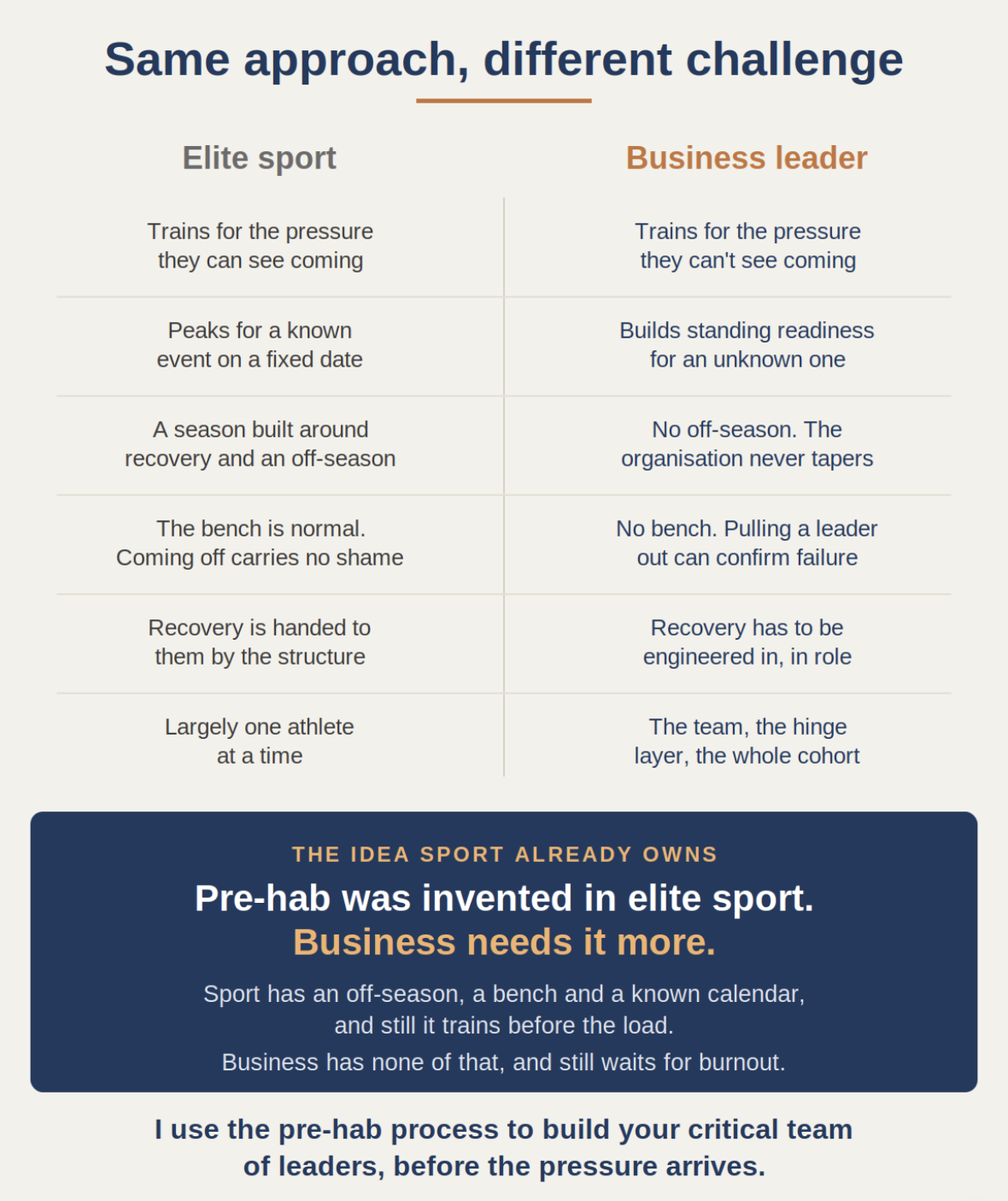
An elite athlete trains for pressure they can see coming. There is a final, race or tournament on a known date, and the season is prepared around being ready to perform. Training builds, recovery is planned, performance peaks and, when necessary, the athlete comes off and sits on the bench without anyone questioning their value.
Business leaders rarely get that luxury.
The pressure is usually not circled on a calendar. It arrives through a resignation, a difficult conversation, a commercial threat, a restructure, a sudden change in direction or a team already stretched beyond capacity. There is no off-season, the organisation never tapers and, for many leaders, stepping away can feel less like sensible recovery and more like failure.
So, while the principles are similar, the challenge is greater. Leaders need standing readiness for pressure they cannot predict, and recovery has to be engineered into the role while they remain responsible for performance and for the people relying on them.
This is where Level Up comes in.
Most leadership programs train capability. Level Up also trains conditioning. It develops the resilience, adaptability, relational intelligence, self-awareness and leadership presence needed when conditions become difficult, uncertain or fast-moving.
Pre-hab is one part of that process. In elite sport, pre-hab training strengthens the joint before it fails. Within Level Up, we apply the same thinking to leadership: try to predict where pressure is likely to land, plan for it, protect the people carrying the load, then help them progress and perform.
But Level Up goes further than protecting one person from burnout. It builds a connected cohort of leaders who can support each other, share the load, respond faster and keep the organisation steady when the weather changes.
Because organisational readiness is not created by strategy alone. It is created by leaders who are robust, resilient and ready for whatever comes next.
Can you name and see the people in your organisation who are carrying the greatest load? Are they genuinely ready for the next stretch, or simply very good at appearing to cope? Are they running on fumes, or ready to pivot?
If that question gives you pause, I am always up for a conversation to help you be ready. For what we can’t always see coming.
